

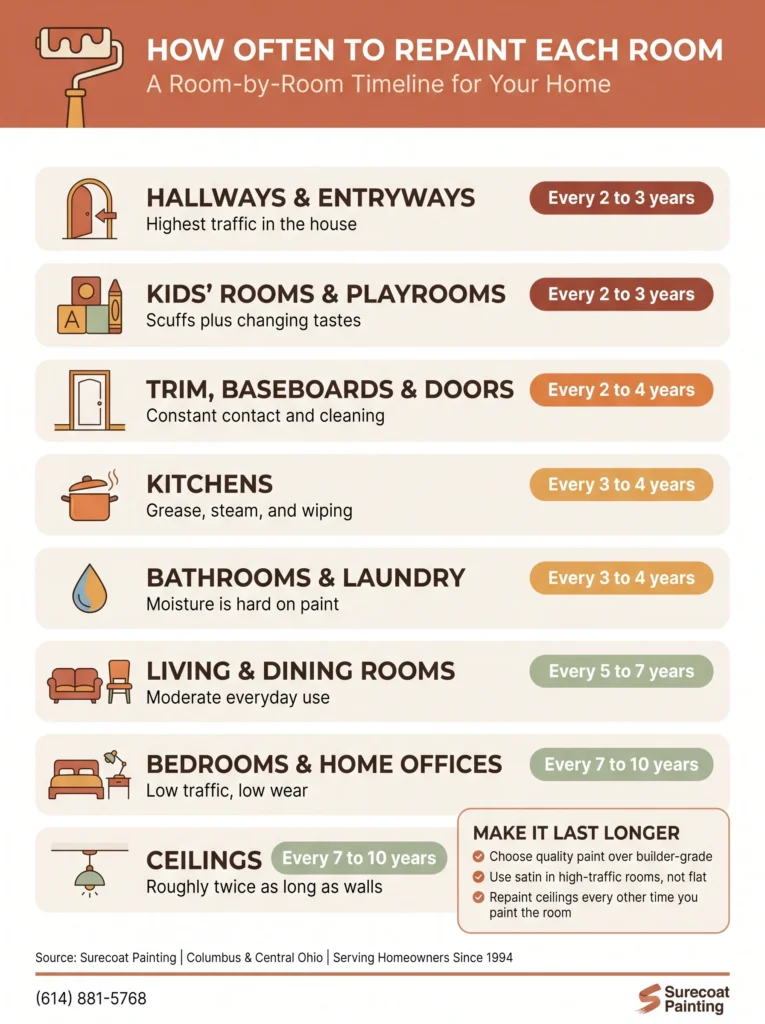
Most interior walls need repainting every 5 to 10 years, though the honest answer depends almost entirely on which room you’re standing in. Hallways and entryways usually need a fresh coat every 2 to 3 years. Kitchens and bathrooms run about 3 to 4 years. Living rooms and dining rooms land around 5 to 7. Adult bedrooms can often stretch to 10. Kids’ rooms rarely make it past 3. Ceilings tend to last roughly twice as long as walls, which is why a good rule of thumb is to repaint ceilings every other time you paint the room. After more than 30 years painting homes across Central Ohio, the crew at Surecoat Painting has learned that these numbers are just a starting point. The choices you make when you paint matter far more than the calendar does.
Here’s the full room-by-room breakdown, and more importantly, how to make every one of those numbers work harder for you.
Quick Answer: The Room-by-Room Timeline
Use this as your baseline, then adjust for your own house.
Hallways, entryways, and mudrooms come in at 2 to 3 years. These take the most physical abuse in any home.
Kids’ bedrooms and playrooms also run 2 to 3 years, though that has as much to do with changing tastes as it does with crayon.
Trim, baseboards, and doors need attention every 2 to 4 years. They get bumped, kicked, and scrubbed more than any wall.
Kitchens land at 3 to 4 years thanks to grease, steam, and constant wiping.
Bathrooms and laundry rooms also run 3 to 4 years, since moisture is hard on paint.
Living rooms and dining rooms sit at 5 to 7 years, sometimes longer if the room is more formal than functional.
Adult bedrooms, home offices, and guest rooms can go 7 to 10 years or more. They’re barely touched.
Ceilings usually last 7 to 10 years, and often longer if the room stays dry.
Why You’ll Find Different Numbers Everywhere You Look
If you’ve searched this before, you’ve probably noticed the answers don’t match. One source says bedrooms every 5 years, another says 10. One says kitchens every 3 years, another says 5. It’s confusing, and nobody explains it.
Here’s why the ranges differ so much: the numbers assume a specific set of conditions, and everybody assumes different ones.
A bedroom painted with quality paint in a two-person household with no pets and no direct sun really can go 10 years looking fine. That same bedroom with builder-grade flat paint, a dog that sleeps against the wall, and a west-facing window will look tired in 4.
So the range isn’t wrong. It’s just incomplete without the context. The useful question isn’t “how long does bedroom paint last.” It’s “what puts my bedroom at the short end or the long end of that range.” That’s what the rest of this covers.
Three Things That Decide Where You Land in the Range
Almost everything that shortens or extends a repaint cycle comes down to three factors. Get these right and you can genuinely double the life of a paint job.
Paint quality is not marketing
There’s a real, measurable difference between cheap paint and good paint, and it comes down to solids content. Higher-grade paints contain more pigment and binder, less filler and water. That means better coverage in fewer coats, a tougher film once it cures, and far better washability.
Builder-grade paint, the stuff used to finish new construction cheaply, is thin. It looks perfectly fine the day it’s applied. Then it starts marking, and once it marks you can’t clean it without burnishing the surface. In a busy hallway, the gap between budget paint and quality paint is easily three or four years.
The math usually works out in favor of the better paint. Paying more once beats paying a full labor cost twice.
Sheen decides how long the paint survives contact
This one gets overlooked constantly, and it might be the single most consequential decision in the whole project.
Sheen is how much light the finish reflects, and it directly controls durability and washability. Flat and matte finishes look beautiful and hide wall imperfections better than anything else, but they’re the least washable. Try to scrub a mark off a flat wall and you’ll often end up with a shiny patch that looks worse than the original mark.
Eggshell has a whisper of sheen and tolerates light cleaning. It’s the sensible default for most bedrooms and formal living rooms.
Satin is where durability really starts. It wipes down well, holds up to contact, and it’s the right answer for hallways, kids’ rooms, kitchens, family rooms, and anywhere life actually happens.
Semi-gloss is standard for trim, doors, baseboards, and bathrooms because it sheds moisture and cleans easily.
The mistake we see in Ohio homes constantly is flat paint in a hallway because someone loved how rich it looked on the swatch. It does look great. For about a year. Then every scuff is permanent, because there’s no way to clean it without making it worse. Move that same hallway to a quality satin and you might not touch it again for five years.
How the room actually gets used
Two identical rooms in two different houses can wear at completely different rates.
Kids and pets are the obvious factor, and the damage concentrates in a specific band roughly between the floor and four feet up. Direct sunlight fades paint faster than most people realize, and you usually don’t notice until you move a picture frame and find a rectangle of the original color underneath. South and west-facing rooms are the most affected.
Then there’s heating, which almost nobody mentions. Forced-air heat is standard across Ohio and most of the Midwest, and running it all winter pulls a serious amount of moisture out of the air. That dryness works on drywall seams and caulk lines, which is part of why you see hairline cracks appear around trim over a few winters. Homes with radiators or baseboard heat get localized wear where warm air rises against the wall above the unit.
Add in the humidity swing between a Midwest summer and a Midwest winter, and drywall is expanding and contracting twice a year, every year. It shows up at the seams eventually.
The Signs That Override the Calendar
Timelines are guidelines. Your walls tell the truth. If you see any of these, the room is due regardless of when it was last painted.
Marks that won’t come off no matter what you clean them with. Once the paint surface has broken down, cleaning just spreads the damage around.
Fading you can actually see, usually revealed the moment you move a couch or take down a picture.
Peeling, cracking, bubbling, or flaking anywhere. That’s adhesion failure and it spreads.
Yellowish or brown staining, which almost always means water got in somewhere and needs to be found before anything gets painted.
Nail pops, hairline cracks along seams, or caulk lines separating from the trim.
Chalky residue on your hand when you touch the wall, which means the binder has broken down.
And the one nobody wants to admit is a legitimate reason: the color just doesn’t work anymore. Maybe your furniture changed, maybe it was the previous owner’s taste, maybe you’ve just looked at it long enough. That’s a fine reason to repaint. It’s a want rather than a need, but it counts.
When You Genuinely Shouldn’t Repaint Yet
Here’s something a painting company doesn’t usually volunteer.
If the paint is basically sound and you’re dealing with a handful of isolated scuffs, touch-up beats a repaint on both cost and hassle. This works best on flat and eggshell, where the touch-up blends. On satin and semi-gloss it’s trickier, because the sheen catches light and a patch tends to show, so those often need a full wall at minimum.
If only the trim looks beat up and the walls are fine, just do the trim. Fresh white trim against slightly older walls makes a whole room read as refreshed, and it’s a fraction of the job.
And if there’s a moisture problem behind the damage, painting is the wrong first move entirely. Find the leak, fix it, let everything dry, then paint. Otherwise the stain comes right back through and you’ve paid for the work twice.
Knowing when not to paint is part of doing this honestly.
If You Can Only Do a Few Rooms This Year
Most people don’t repaint a whole house at once. Here’s how to sequence it when the budget sets the pace.
Start with the entry and main hallway. It’s the highest-impact spend in the house, because it’s the first thing anyone sees and it’s almost always the most worn.
Next, handle anything that’s actively getting worse. Peeling in a bathroom or staining anywhere isn’t cosmetic, it’s a problem that compounds. Waiting makes that job bigger and more expensive.
Third, the main living space, since that’s where you and your guests actually spend time.
Leave the guest room, the home office, and the ceilings for later. They can wait, and nobody will notice.
Plenty of homeowners phase a whole house over two or three years this way, hitting the hardest-working rooms first. By the time you circle back, the early rooms are still holding up.
What Waiting Too Long Actually Costs
Putting off a repaint past the point of failure doesn’t just look rough. It changes what the job is.
Once paint peels or flakes, the surface underneath is exposed. Drywall starts absorbing moisture, taking stains, and picking up damage that has to be repaired before anything new goes on. Prep goes from a quick clean and light sand to patching, skim coating, and priming. That’s real hours added to the job.
Old water stains often need a shellac-based stain-blocking primer, or they’ll bleed straight through the new paint. Same story with nicotine damage in homes where someone smoked indoors.
The pattern is simple: a repaint done on time is mostly painting. A repaint done five years late is mostly repair. The paint itself is rarely what makes the invoice big.
What Drives the Cost
Prices vary too much by market for a number to mean anything here, but these are the factors that actually move it.
Square footage and ceiling height matter most, and a two-story foyer costs far more than its square footage suggests because of the equipment and time involved. Prep condition is the wild card, as covered above. Every additional color adds cutting-in and cleanup time. Trim, doors, and cabinetry price separately from walls because they’re slow detail work. A fully furnished room takes longer to protect and work around than an empty one. And paint grade is a genuine line item, though it’s usually the last place to cut.
One honest piece of advice: the lowest bid usually means thinner paint, less prep, or fewer coats. Sometimes all three. That’s not a savings, it’s a shorter repaint cycle you haven’t been told about yet.
A Note for Landlords and Property Managers
Rental repaint cycles follow completely different logic than owner-occupied homes.
Most units get repainted at turnover rather than on a schedule, which works out to every 1 to 3 years depending on tenancy length and condition. The optimization target is different too. You’re solving for fast turnaround, durability, and consistency across units, not personal taste.
The setup most property managers land on is a single neutral wall color across the entire portfolio, satin or eggshell for washability, semi-gloss on all trim and doors, and the exact product and color code kept on file so touch-ups between full repaints take minutes instead of a day. That approach cuts both cost and vacancy time.
For multi-family properties, batching repaints during lower-turnover months tends to beat handling units one at a time.
Bottom Line
Interior paint generally lasts 5 to 10 years, with hallways needing attention every 2 to 3 and quiet bedrooms sometimes going a full decade. But the range is only useful once you know what determines where you fall inside it.
Paint quality, sheen, and how the room gets used matter more than the calendar. Those are all decisions you control, and getting them right can add years to every room in the house.
If your walls are showing marks that won’t clean, fading you can spot when you move furniture, or paint that’s cracking or peeling, that’s your answer no matter what the timeline says. And if you’re genuinely unsure whether a room needs a full repaint or just a touch-up, that’s worth asking someone who looks at walls for a living.
Frequently Asked Questions
Does expensive paint actually last longer?
Yes, and the difference is larger than most people expect. Higher-grade paints have more pigment and binder and less filler, which means better coverage, a tougher finish, and much better washability. In a high-traffic room, quality paint can add several years to the cycle, which usually makes it cheaper over the long run than buying budget paint twice.
How do I know if it’s normal wear or a real problem?
Normal wear looks like scuffs, dullness, and gradual fading. Warning signs of something bigger include bubbling or peeling (moisture or adhesion failure), yellow or brown staining (a leak), cracks that keep reappearing along the same seam (movement or settling), or musty smell with discoloration (possible mold). Those need the cause addressed before any paint goes on.
Should I repaint before selling my house?
Usually yes, and it’s one of the highest-return things you can do before listing. Fresh neutral paint makes a house read as brighter, cleaner, and better maintained, and it lets buyers picture their own belongings in the space. Prioritize the entry, main living areas, and any room with a bold or dated color.
Can I just touch up instead of repainting the whole room?
Often yes, if the paint is otherwise sound and you still have the original paint or the color code. Touch-ups blend well on flat and eggshell finishes. On satin and semi-gloss they tend to show, because the sheen reflects light differently on the patch, so those rooms usually need at least a full wall for a seamless result.